
A tank, Tiger II at Normandy Victory Museum
To mark the 80th anniversary of the Normandy landings, the Normandy Victory Museum A legendary tank, the only operational Tiger II in the world thanks to the restoration work of the Tank Museum in Saumur, was presented. This highlight attracted history and military vehicle enthusiasts, as well as a large public eager to discover this iconic World War II tank. On this occasion, the Tank Museum unveiled to visitors a brand-new camouflage pattern faithful to that used in the Normandy battles.
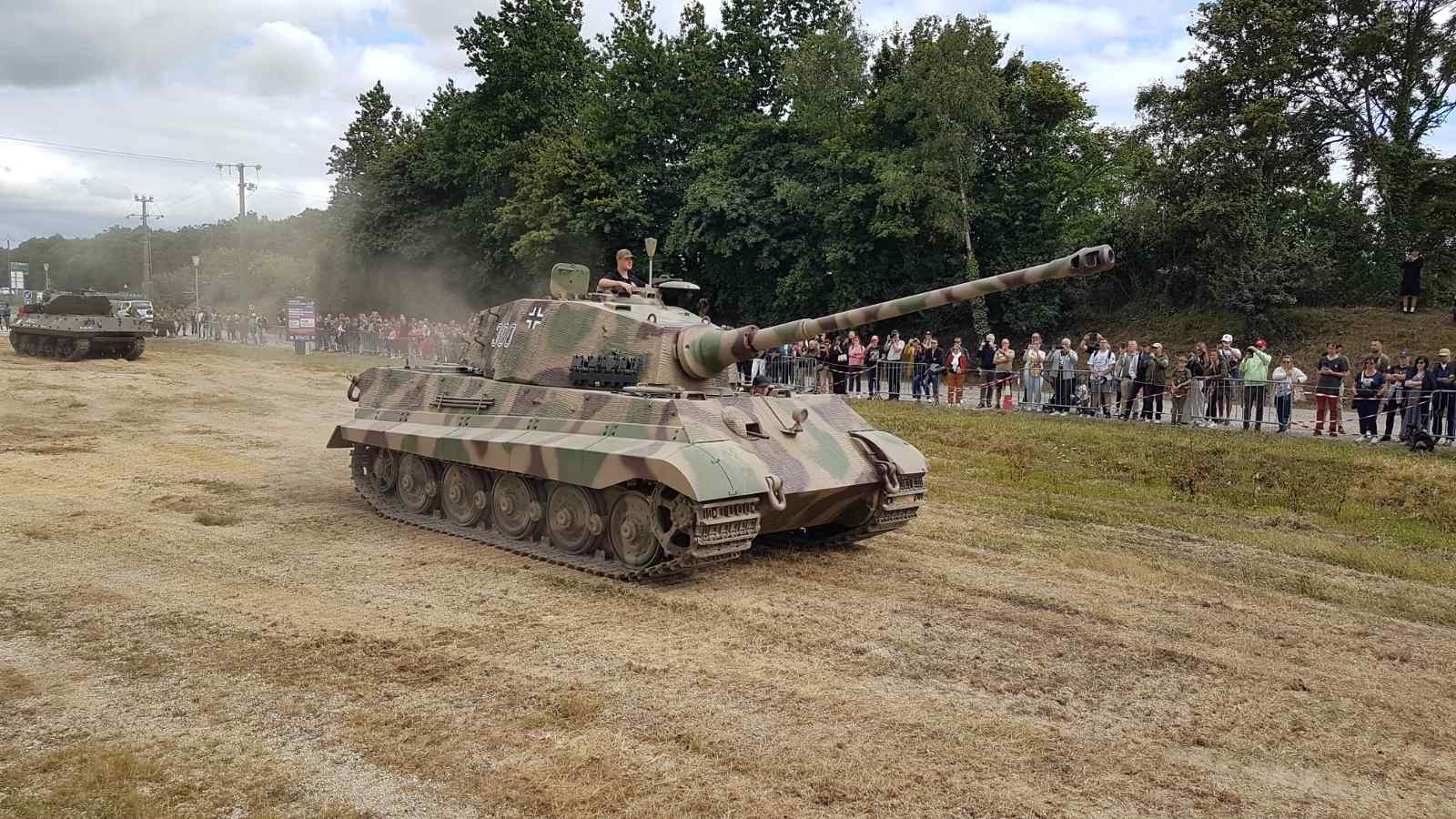
Weighing almost 70 tons, the Tiger II, also known as the King Tiger, was the heaviest armored vehicle mass-produced by the German army, of which 489 were manufactured during World War II. Intended to replace the Tiger I, its design began in May 1941, and the first units were delivered in early 1944. Its impressive mass was due to its thick sloped armor, particularly on the front, measuring 18,5 cm on the turret and 15 cm on the hull.
A powerful but not very mobile tank
The Tiger II was a heavy tank designed to break through a well-defended front and dominate the battlefield. Indeed, it distinguished itself from other armored vehicles of its time by its firepower. It was equipped with a 700-horsepower HL 230 P30 V12 gasoline engine, designed by Maybach, the same engine that powered the Panther and Tiger I tanks. However, while this engine was sufficient for those earlier models, it was not adequate for the Tiger II, whose considerable weight affected both its mobility and, above all, its reliability.
Its often misinterpreted range is actually quite reasonable for a 70-ton tank. It consumes 505 liters per 100 km on roads. Its 860-liter fuel tank gives it a range of 170 km on roads and 110 to 120 km off-road, or 60 to 80 liters per hour, whereas a modest 32-ton Sherman M4 can guzzle 120 liters per hour and consume 450 liters per 100 km.
However, it was clear that the HL230P30 engine was underpowered, and despite its significant torque of 1850 Nm, the 70-ton weight was too noticeable, especially on heavy terrain. The Germans even nicknamed it "Die Schnecke" (The Slug) because the Tiger II could barely move faster than 15 km/h on heavy ground.
Offensive yet protected, the Tiger II is a formidable armored vehicle.
The Tiger II was armed with a formidable gun, the 8.8 cm KwK 43 L/71, 6,30m long and capable of hitting its target several kilometers away. This gun instilled terror in the Allied troops because it was capable of penetrating any armored vehicle located within 4500m.
The fighting in Normandy: the fierce battle of the Tiger II
During the Battle of Normandy, twelve Tiger II tanks belonging to the 1.s.pz.Abt.503 of the Heer found themselves immersed in the fighting on the plain of Caen in July 1944. They travelled 190 km by road from the Dreux unloading station to reach the Emieville area east of Caen.
This heavy tank, with its impressive armor and formidable firepower, nevertheless found itself in difficulty during Operation Goodwood on July 18, 1944. After surviving the most powerful aerial bombardment known in Western Europe (8,000 tons of bombs over 15km2), the surviving Tiger IIs would then face more than 1,000 Allied armored vehicles.
Four Tiger IIs were lost during the day of July 18, 1944; the eight surviving Tiger IIs were moved by road for 55 km to fight in Suisse Normandie, on Mont Pinçon; and two other Tiger IIs were destroyed.
In mid-August, the order to retreat was given. The surviving Tiger IIs moved in a slow, agonizing death, left to their own devices until they reached the Falaise pocket, where they were all destroyed. None reached the Seine.
On the Mailly le Camp side, the 3.s.pz.Abt.503 which was destroyed on 18.07.1944 at Emieville was reconstituted with fourteen new Tiger IIs between 26 July 1944 and 12 August 1944.
A new mission begins: after being unloaded, the Tigers must cross Paris (August 20, 1944) and then reach the American beachhead at Mantes la Jolie.
Of the fourteen Tiger IIs, only nine will reach the Vexin Normand region where terrible battles still await them. They will have to face 50,000 American soldiers, 500 Allied armored vehicles, 2 million landmines and just as much artillery fire.
It was on August 28, 1944, that the Tiger II 300 of Hauptmann Walter Scherf (the one that visitors to the Normandy Victory Museum (as seen during the week of June 6, 2024), will break down at Oinville en Vexin. Company Warrant Officer Klaus Neeb took 18 hits on his Tiger II 301 before abandoning it.
The surviving Tiger IIs of the 3.s.pz.Abt.503 will attempt to reach Belgium by road, but the last Tiger II 324 from Rambow will run out of fuel on the outskirts of Amiens.
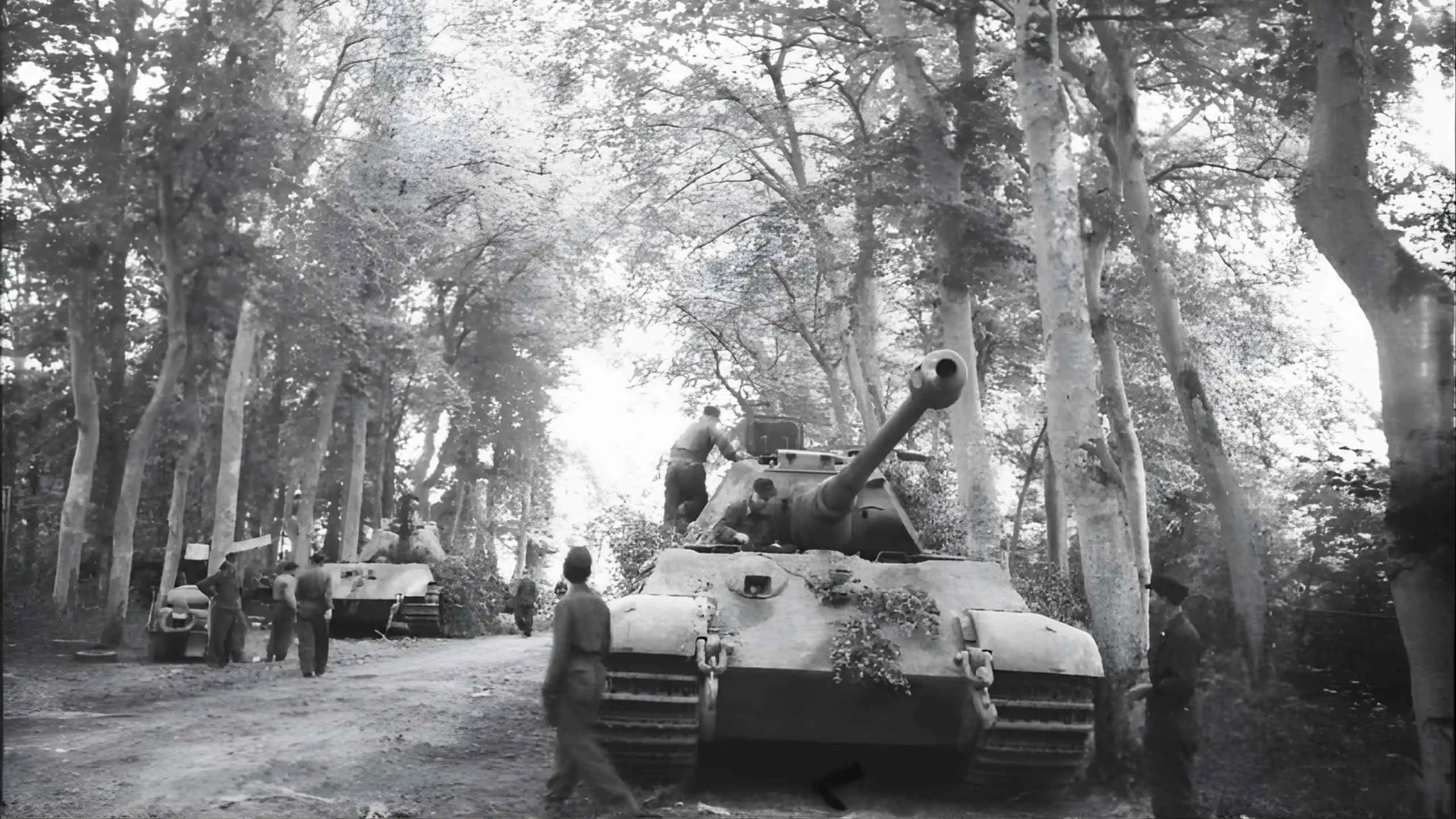
Tank Panzer VI “Tiger II” (Königstiger) park of Canteloup castle ©bundesarchiv_bild_101i-721-0359-37
Myths and reality
An easy-to-drive armored vehicle
Surprisingly, and despite its 70 tons, the Tiger II is disconcertingly simple to drive. Indeed, unlike the American Sherman, it is steered using a hydraulically assisted steering wheel of the Henschel L 801 type with a double differential, which allows the Tiger II to turn more quickly through 360° and to have two types of turning radii (a large and a small one), like the Tiger I.
Its Maybach Olvar Type EG 40 12 16 B pre-selector gearbox with 12 speeds (8 forward and 4 reverse) allows for clutchless upshifts and downshifts. This modern technology makes it easy to drive for a driver trained in its operation.
The truth about the turrets
Many myths persist in the world of tanks, and the Tiger II is no exception. Indeed, it's common to hear about a "Porsche" or "Henschel" turret. These designations are incorrect. While Henschel and Porsche did compete to design the tank's chassis during its development, both turrets were actually designed by Krupp.
The confusion may stem from the fact that the first 50 turrets were intended for Porsche's tank, as the company had become somewhat overconfident about its chances of victory. However, Henschel won the contract, and this first type of turret was mounted on its chassis. A second type of turret, better protected and simpler to produce, would equip the majority of Tiger II tanks. Krupp called it the "standard turret," and it is the one on the tank displayed at the Saumur Tank Museum.
Zimmerit: a unique protection
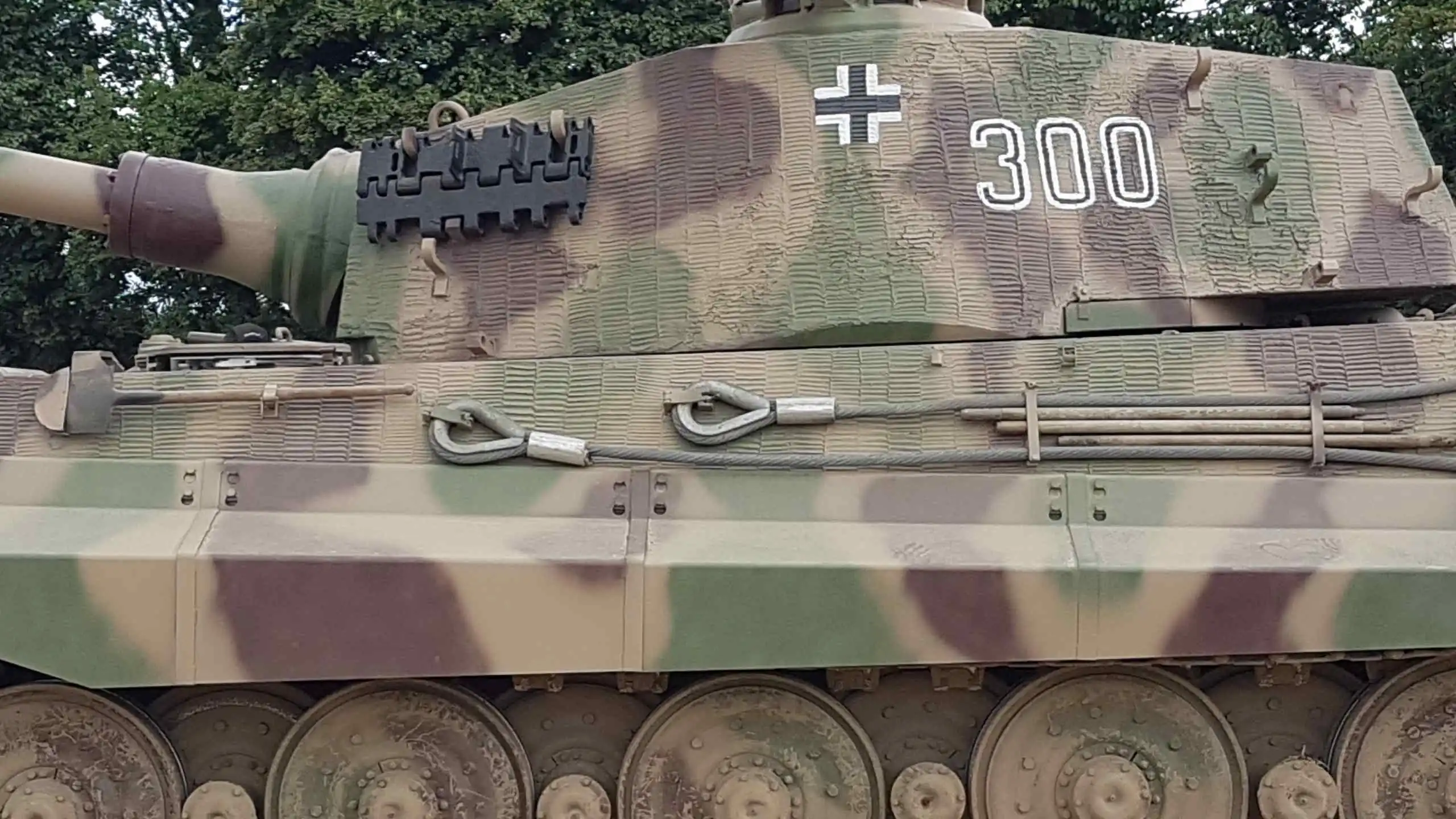
A recurring question among tank enthusiasts concerns the particular texture of German tanks, coated with Zimmerit from December 1943. This special coating, applied in the form of grooves, was intended to prevent the adhesion of magnetic mines used only by the German infantry, for fear that this technology would be copied by the Allies.
Although Zimmerit was not anti-magnetic, it created a barrier preventing explosives from directly adhering to the tank's steel, causing them to fall off instead of detonating. This innovation represented a significant advancement in armored vehicle protection.
The restoration of the Tiger II by the Saumur Tank Museum
The tank presented by the Tank Museum during the 80th anniversary of the landings is a post-war assembly of two Tiger IIs, combining the turret and mechanical components of Tiger II No. 300 and the chassis of Tiger II No. 123. An assembly which made it possible to carry out a battery of tests for the French army.
The Tiger II arrived in Saumur in February 1975, and it was from 1983, the year the tank museum opened to the public, that visitors were able to see it. At that time, it sported a two-tone camouflage scheme and the number 233, by which it has been known ever since.
When the Tiger II 233 becomes the Tiger II 300
After several years of research, and to celebrate the 80th anniversary of the Normandy landings, the Tank Museum had prepared a wonderful surprise for us: a brand new camouflage pattern and serial number. Thus, Tiger II No. 233 now bears the number 300 of Hauptmann Scherf and sports the exact camouflage it wore during the Normandy battles mentioned earlier in this article.
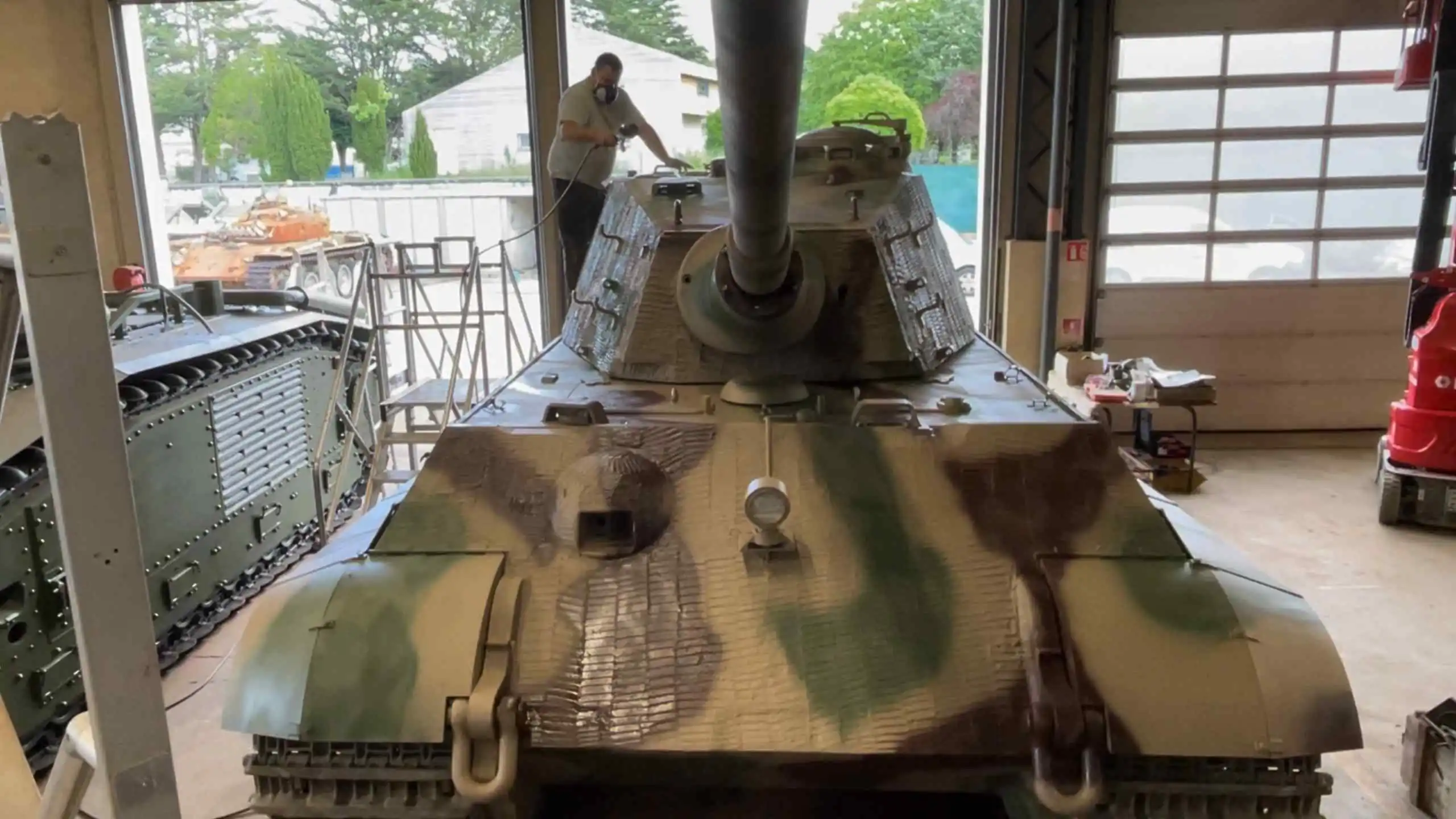
The Tiger II in paint during its restoration at the Tank Museum in Saumur (rights reserved Tank Museum of Saumur)
Technical specifications of the Tiger II
Technical name
- PzKpfw VI Königstiger – SdKfz 182
Generalities
- Length: 10,28 m
- Beam: 3,65 m
- Height: 3,09 m
- Mass: 69,800 kg
- Crew: 5 people (tank commander, driver, co-driver/gunner, loader, gunner)
Engine
- Engine: Maybach HL 230 P30, V12, gasoline, 700 horsepower
- Maximum speed: 38 km / h
- Fuel consumption: 380 to 505 liters per 100 km on roads and 650 to 800 liters per 100 km in extreme terrain
- Fuel tank: 860 liters (gasoline)
- Range: 170 km on the road – 110/120 km off-road
armouring
- Front armor: 150 mm (hull), 185 mm (turret)
- Side armor: 80 mm
Armaments
- Main armament: 8.8 cm KwK 43 L/71 gun
- Secondary armament: two 7,92 mm MG 34 T machine guns.
The arrival of Tiger II at Normandy Victory Museum It was a real popular success. Many visitors came to admire this powerful tank as well as other models brought by the Tank Museum of Saumur, a long-standing partner of our museum whom we thank again for this great collaboration.
Thanks also to Max Stein for proofreading the article. He is the author of a captivating book that we recommend to enthusiasts, which tells the story of Tiger I 114: “The Tiger of Saumur, the Resurrection of the Beast” (bilingual French/English). You can find it in our shops (at the museum and online).